

 Deutsch
QST products - PinPrick stimulators
Quantitative sensory testing (QST) of pain and perception thresholds
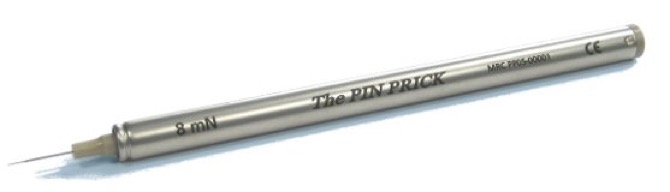
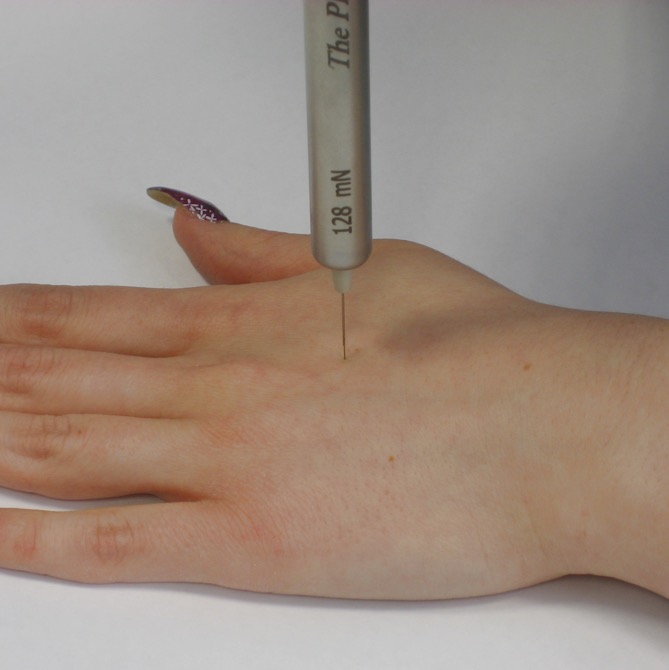
MRC's PinPrick stimulators are used for quantitative sensory testing (QST) of pain and perception thresholds. They allow a reproducible measurement and documentation of nociceptor activation of the skin. Thus, they enable a better diagnostic of symptoms of neuropathologic pain and the investigation of mechanisms that are connected with chronic pain.
The tactile stimulators have been developed and introduced by Prof. Rolf-Detlef Treede and PD Dr. Walter Magerl (Department of Neurophysiology, Medical Faculty Mannheim, University of Heidelberg). They are used by the members of the German Research Network on Neuropathic Pain (DFNS) and validated by the European Federation of Neurological Societies.
Information on PinPrick
Further QST products
- Thermal stimulation - MEDOC products
- OptiHair2 - von Frey filaments
- EPS-P10 - High frequency stimulation electrode
Further information
All products are directly available from us.
For further information or to get a quotation please give us a call or send an email.
Applications
Pinprick stimulation ...
- is used to assess gain and loss of mechanical sensory functions
- is one important contribution to characterize the somatosensory phenotype of patients with neuropathic pain
- provides quantitative data for mechanical detection and pain thresholds as well as stimulus/response functions
- provides quantitative data for pain summation to repetitive stimuli
- is an important step towards mechanism based treatment of pain syndromes
- is a reproducible method to diagnose changes of pain sensitivity like mechanical hyperalgesia or dynamic mechanical allodynia
- is used to investigate the central sensitization to A-fibre nociceptor input
- enables the validation of pain treatment concepts by standardized protocols and absolute reference values
Product description
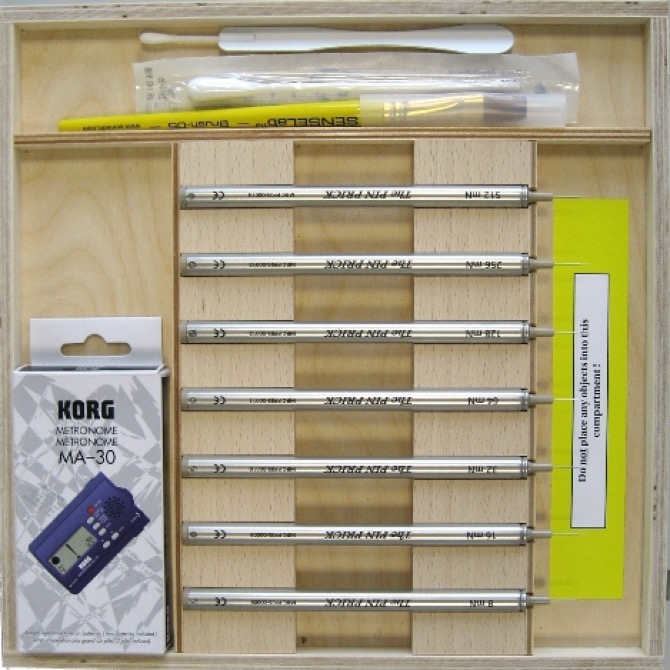
- One set includes seven weighted pinprick stimulators for different pressures (between 8mN and 512mN)
- Tips have a flat contact area of 0.25mm in diameter with a controlled edge curvature
Special properties
- Fast and safe application in clinical routine
- Approved tip geometry
- Calibrated forces
- User-independent sensoric stimulation levels
- No damage to skin tissue
- Age- and gender-matched reference values are available
- Recommended by German Research Network of Neuropathic Pain (DFNS)
- Recommended by European Federation of Neurological Societies
- Compact and robust design
- Patented technology
- The MRI compatible version can be used during MRI, fMRI, and PET imaging
Further product information
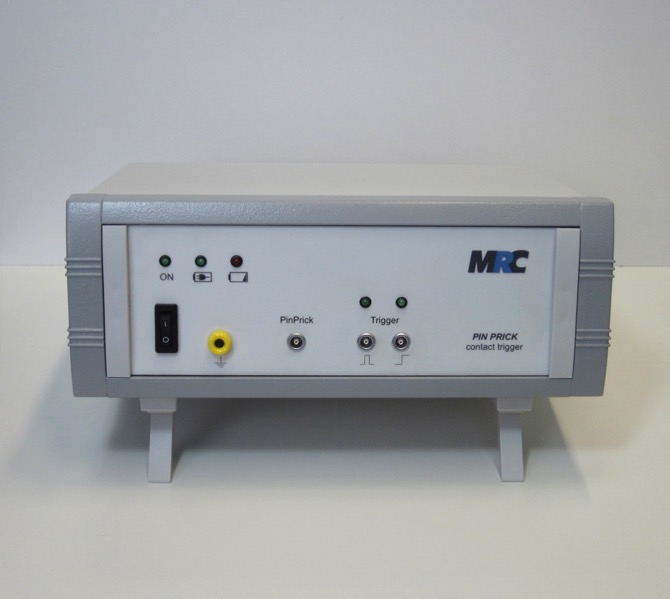
The trigger can be used to determine the conduction velocity of nerves. As soon as the tip of a PinPrick stimulator reaches its nominal force on the skin, a trigger signal is generated. This trigger can be sent to a stop watch, an EEG recorder or any other device.
Further product information
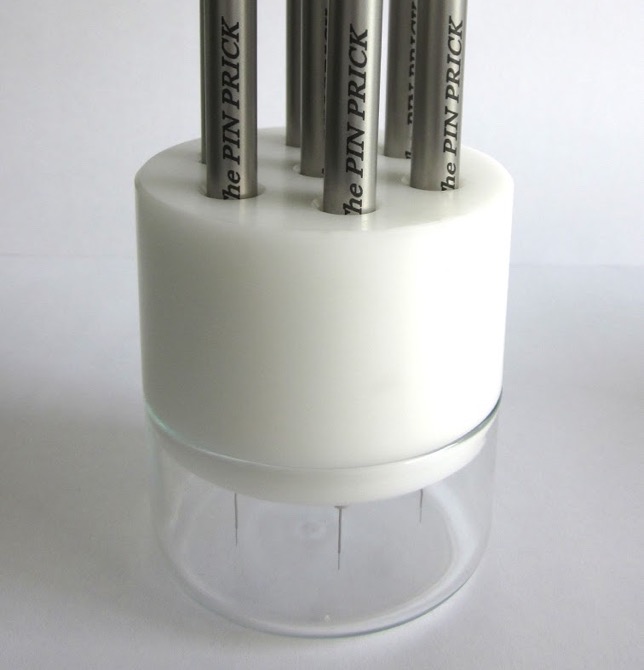
For easy and safe disinfection of the PinPrick stimulators we offer the disinfection unit as accessory. The glass jar can be filled with a standard disinfectant for medical products. The PinPrick holder ensures dipping the pins into the disinfectant.
Further product information

Since April 2019 we are the exclusive service and sales partner of Medoc in Germany. Below you can find a link to the specific website with more details about the products from Medoc.
Further information
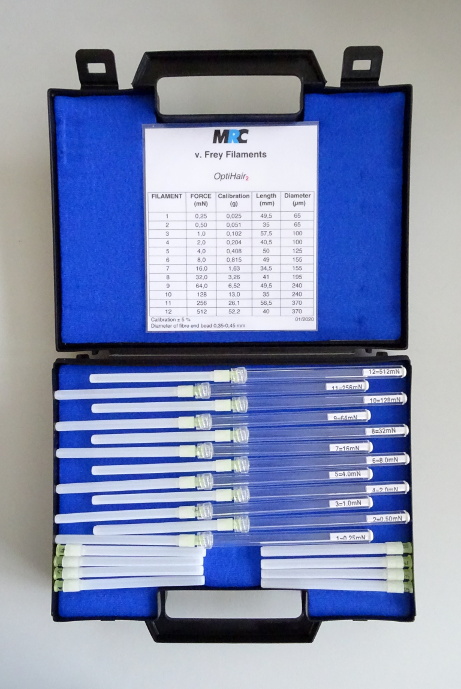
The "OptiHair2" - von Frey filaments are used to investigate the tactile detection threshold in quantitative sensory testing (QST).
Developed in 1896 by Maximiliam von Frey, human hair and animal bristles of different lengths were originally used to achieve defined levels of stimulation. Today, synthetic fibres are often used, but these have plastic properties and are sensitive to room temperature and humidity. In contrast, the "OptiHair2" von Frey filaments use optical glass fibres, which are highly elastic and are not affected in their stiffness by normal climatic fluctuations. This allows a simple and reproducible application.
The "OptiHair2" were manufactured and distributed over many years by the German company Marstock. They have found wide distribution in this field. Since 2020 we have added the product to our QST portfolio.
Product description / Special properties
- The OptiHair2 set contains 12 von Frey filaments with handle and protective cap and 8 spare filaments
- Forces: 0.25 to 512 mN, each graduated by a factor of 2
- Standardized spherical fibre end with constant contact area. This prevents undesired irritation of nociceptors
- Recommended by the German Research Network on Neurophathic Pain (DFNS)
Further product information
The stimulation electrode "EPS-P10" is used to deliver current pulses from an external source through the skin to a subject. Such stimulating current pulses can be used, for example, to determine the perception or pain threshold for an electrical stimulus.
Another application is the evocation of secondary hyperalgesia. This hyperalgesia can last for several hours and can be used to simulate chronic hypersensitivity in healthy subjects. In order to evoke the hyperalgesia repeated current pulses with intensities above the pain threshold of the subject can be delivered to the skin.

Product description / Special properties
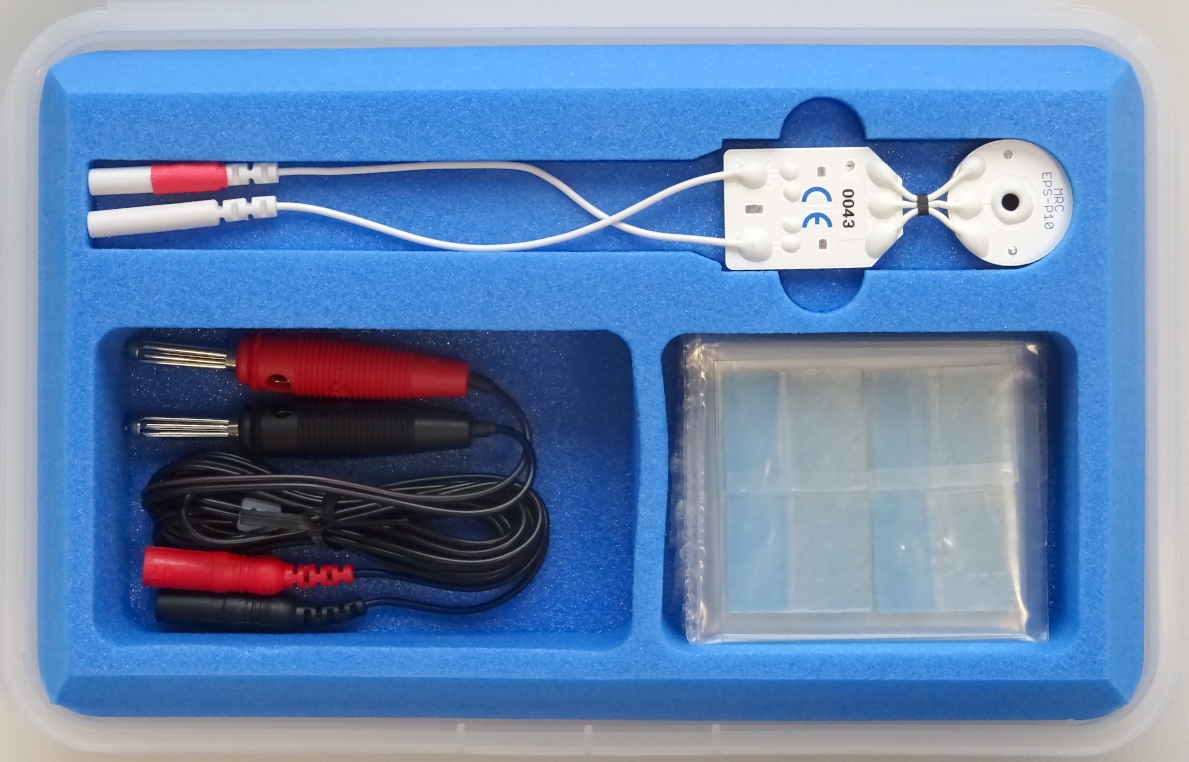
The cathode of the "EPS-P10" consists of ten thin pins made of tungsten with a defined diameter of 0.25mm. The anode is used for the safe discharge of the current. Thus, even at low current intensities, the necessary current densities for the excitation of free nerve endings of Aδ and C fibers in the skin can be achieved. Anode and cathode of the "EPS-P10" are mechanically connected. Due to the highly flexible cables the electrode can be easily placed at variable positions.
- cathode consisting of ten stable pins made of tungsten with a diameter of 0.25mm
- anode with an area of about 410mm²
- designed for multiple uses, easy to disinfect
- incl. adhesive pads to fix the "EPS-P10" to the skin
- medically approved (CE-marking)
- used at various centres in the European research project IMI-PainCare
Further product information
Publications / references
PinPrick stimulators
- Geber C, Klein T, Azad S, Birklein F, Gierthmühlen J, Huge V, Lauchart M, Nitzsche D, Stengel M, Valet M, Baron R, Maier C, Tölle T, Treede RD: Test-retest and interobserver reliability of quantitative sensory testing according to the protocol of the German Research Network on Neuropathic Pain (DFNS): a multi-centre study. Pain. (2011) Mar;152(3):548-56. (Weblink)
- Klein T, Magerl W, Hanschmann A, Althaus M, Treede RD: Antihyperalgesic and analgesic properties of the N-methyl-D-aspartate (NMDA) receptor antagonist neramexane in a human surrogate model of neurogenic hyperalgesia. European Journal of Pain, 12 (2008), 17-19 (Weblink)
- Magerl W, Krumova EK, Baron R, Tölle T, Treede RD, Maier C.: Reference data for quantitative sensory testing (QST): refined stratification for age and a novel method for statistical comparison of group data. Pain. (2010) Dec;151(3):598-605. (Weblink)
- Magerl W, Fuchs PN, Mayer RA, Treede RD: Roles of capsaicin-insensitive nociceptors in pain and secondary hyperalgesia. Brain 124 (2001), 257-268 (Weblink)
- Maier C, Baron R, Tölle TR, Binder A, Birbaumer N, Birklein F, Gierthmühlen J, Flor H, Geber C, Huge V, Krumova EK, Landwehrmeyer GB, Magerl W, Maihöfner C, Richter H, Rolke R, Scherens A, Schwarz A, Sommer C, Tronnier V, Uçeyler N, Valet M, Wasner G, Treede RD: Quantitative sensory testing in the German Research Network on Neuropathic Pain (DFNS): somatosensory abnormalities in 1236 patients with different neuropathic pain syndromes. Pain. (2010) Sep;150(3):439-50 (Weblink)
- Pfau DB, Krumova EK, Treede RD, Baron R, Toelle T, Birklein F, Eich W, Geber C, Gerhardt A, Weiss T, Magerl W, Maier C: Quantitative sensory testing in the German Research Network on Neuropathic Pain (DFNS): reference data for the trunk and application in patients with chronic postherpetic neuralgia. Pain. (2014) May;155(5):1002-15. (Weblink)
- Rolke R, Magerl W, Campbell KA, Schalber C, Caspari S, Birklein F, Treede RD: Quantitative sensory testing: a comprehensive protocol for clinical trials. Eur J Pain 10(1) (2006), 77-88 (Weblink)
- Rolke R, Baron R, Maier C, Tölle TR, Treede RD, Beyer A, Binder A, Birbaumer N, Birklein F, Bötefür IC, Braune S, Flor H, Huge V, Klug R, Landwehrmeyer GB, Magerl W, Maihöfner C, Rolko C, Schaub C, Scherens A, Sprenger T, Valet M, Wasserka B: Quantitative sensory testing in the German Research Network on Neuropathic Pain (DFNS): Standardized protocol and reference values. Pain 123 (2006), 231-243 (Weblink)
- Schuh-Hofer S, Wodarski R, Pfau DB, Caspani O, Magerl W, Kennedy JD, Treede RD: One night of total sleep deprivation promotes a state of generalized hyperalgesia: a surrogate pain model to study the relationship of insomnia and pain. Pain. (2013) Sep;154(9):1613-21. (Weblink)
- Ziegler EA, Magerl W, Meyer RA, Treede RD: Secondary hyperalgesia to punctate mechanical stimuli. Brain 122 (1999), 2245-2257 (Weblink)
OptiHair2 - Von Frey Filamente
- Andrews K: The effect of changes in temperature and humidity on the accuracy of von Frey hairs. J Neurosci Methods (1993); 50:91-93. (Weblink)
- Fruhstorfer H, Gross W, Selbmann O: von Frey hairs: new materials for a new design. Eur J Pain. (2001); 5: 341-342 (Weblink)
- Rolke R, Baron R, Maier C, Tölle TR, Treede RD, Beyer A, Binder A, Birbaum N, Birklein F, Bötefür IC, Braune S, Flor H, Huge V, Klug R, Landwehrmeyer GB, Magerl W, Maihöfner C, Rolko C, Schaub C, Scherens A, Sprenger T, Valet M, Wasserka B: Quantitative sensory testing in the German Research Network on Neuropathic Pain (DFNS): Standardized protocol and reference values. Pain (2006).
- von Frey M. Ueber den Gebrauch von Reizhaaren. In: Untersuchungen über die Sinnesfunctionen der menschlichen Haut. Erste Abhandlung: Druckempfindung und Schmerz. Abhandlungen der mathematisch-physischen Classe der Königlich Sachsischen Gesellschaft der Wissenschaften (1896);23: 208-217 (Weblink)
EPS-P10 - Hochfrequenz-Stimulationselekrode
- Klein T, Magerl W, Hopf HC, Sandkühler J, Treede RD: Perceptual Correlates of Nociceptive Long-Term Potentiation and Long-Term Depression in Humans. JNeurosci (2004) (Weblink)
- Leone C, Di Lionardo A, Di Pietro G, Di Stefano G, Falco P, Blockeel AJ, Caspani O, Garcia-Larrea L, Mouraux A, Phillips KG, Treede RD, Truini A: How different experimental models of secondary hyperalgesia change the nociceptive flexion reflex. Clinical Neurophysiology (2021)
- Manresa JB, Andersen OK, Mouraux A, van den Broeke EN: High frequency electrical stimulation induces a long-lasting enhancement of event-related potentials but does not change the perception elicited by intra-epidermal electrical stimuli delivered to the area of increased mechanical pinprick sensitivity. PLOS ONE (2018) (Weblink)
- Nochi Z, Pia H, Pelz B, Götz M, Höink JN, Kostenko A, Wittayer M, Caspani O, Treede RD, Tankisi H, Finnerup NB: Edit Investigation of Potential Effects of High Frequency Electrical Stimulation on Small Sensory Fibers using Perception Threshold Tracking. Conference Paper on IASP World Congress on Pain (2020).
- Pia H, Nochi Z, Pelz B, Götz M, Höink JN, Treede RD, Finnerup NB, Tankisi H: Perception threshold tracking (PTT) - A novel method to assess the small fiber function. Conference Paper on IASP World Congress on Pain (2020).
- van den Broeke EN, Mouraux A: High-frequency electrical stimulation of the human skin induces heterotopical mechanical hyperalgesia, heat hyperalgesia, and enhanced responses to nonnociceptive vibrotactile input. J Neurophysiol (2014) (Weblink)